

2025-06-13
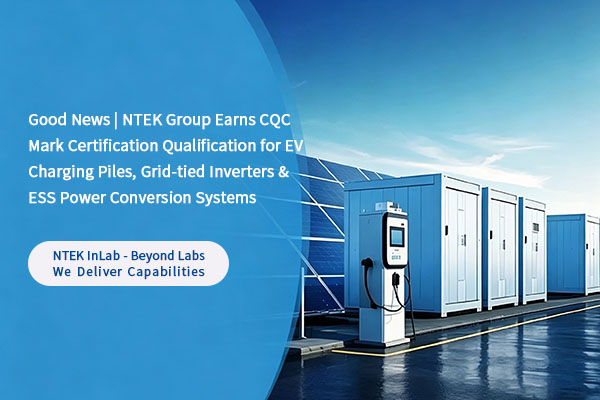
Good News | NTEK Group Earns CQC Mark Certification Qualification for EV Charging Piles, Grid‑tied Inverters & ESS Power Conversion Systems
PV and Electrical Energy Storage Products
Category 024 covers two sub‑categories for PV and electrical energy storage products:
1‑1 Grid‑tied Inverter, Certification Code: 024005
> Certification Rules
- CQC33‑461239‑2018 *Rules for Certification of PV Grid‑tied Inverters*
> Applicable Standards
- NB/T 32004‑2018 *Technical Specification for PV Grid‑tied Inverters*
- GB/T 37408‑2019 *Technical Requirements for Grid‑connected PV Inverters*
1‑2 Power Conversion System (PCS) for Energy Storage, Certification Code: 024016**
> Certification Rules
- CQC33‑461296‑2024 *Rules for Certification of Power Conversion Systems for Energy Storage*
> Applicable Standards
- GB/T 34120‑2023 *Technical Requirements for Power Conversion Systems of Electrochemical Energy Storage Systems*
- GB/T 34133‑2023 *Test Technical Specification for Power Conversion Systems for Energy Storage*
Electric Vehicle Charging Facilities
Category 127 includes three sub‑categories for electric vehicle charging facilities
2‑1 Off‑board Electric Vehicle Charger, Certification Code: 127001
> Certification Rules
- CQC14‑464232‑2022 *Rules for Certification of Off‑board Electric Vehicle Chargers*
> Applicable Standards
- GB/T 18487.1‑2023 *Electric vehicle conductive charging system — Part 1: General requirements*
- GB/T 18487.2‑2017 *Electric vehicle conductive charging system — Part 2: EMC requirements for off‑board conductive power supply equipment*
- GB/T 27930‑2023 *Digital communication protocol between off‑board conductive chargers and electric vehicles*
- GB/T 34657.1‑2017 *Interoperability test specification for electric vehicle conductive charging — Part 1: Power supply equipment*
- NB/T 33001‑2018 *Technical conditions for off‑board conductive electric vehicle chargers*
- NB/T 33008.1‑2018 *Test specification for electric vehicle charging equipment — Part 1: Off‑board chargers*
- GB/T 39752‑2021 *Safety requirements and test specification for electric vehicle power supply equipment*
2‑2 Electric Vehicle In‑cable Control and Protection Device (IC‑CPD), Certification Code: 127002
> Certification Rules
- CQC14‑464233‑2022 *Rules for Certification of Electric Vehicle In‑cable Control and Protection Devices*
> Applicable Standards
- GB/T 18487.1‑2023 *Electric vehicle conductive charging system — Part 1: General requirements
- GB/T 18487.2‑2017 *Electric vehicle conductive charging system — Part 2: EMC requirements for off‑board conductive power supply equipment*
- GB/T 34657.1‑2017 *Interoperability test specification for electric vehicle conductive charging — Part 1: Power supply equipment*
- GB/T 39752‑2021 *Safety requirements and test specification for electric vehicle power supply equipment*
2‑3 AC Electric Vehicle Charging Pile, Certification Code: 127003
> Certification Rules
- CQC14‑464234‑2022 *Rules for Certification of AC Electric Vehicle Charging Piles*
> Applicable Standards
- GB/T 18487.1‑2023 *Electric vehicle conductive charging system — Part 1: General requirements*
- GB/T 18487.2‑2017 *Electric vehicle conductive charging system — Part 2: EMC requirements for off‑board conductive power supply equipment*
- GB/T 34657.1‑2017 *Interoperability test specification for electric vehicle conductive charging — Part 1: Power supply equipment*
- NB/T 33002‑2018 *Technical conditions for AC electric vehicle charging piles*
- NB/T 33008.2‑2018 *Test specification for electric vehicle charging equipment — Part 2: AC charging piles*
- GB/T 39752‑2021 *Safety requirements and test specification for electric vehicle power supply equipment*
Significance of CQC Mark Certification
Upon obtaining CQC Mark Certification, enterprises are permitted to affix the CQC mark to certified products. The mark indicates that products meet relevant certification requirements for quality, safety, performance, electromagnetic compatibility and other aspects, delivering reliable products for end‑users.
CQC Mark Certification brings the following benefits for enterprises:
- Build brand image, improve market competitiveness, obtain a “green pass” for market access, increase market share, and help enterprises achieve both economic and social benefits.
- Product cost control: Widely recognized and adopted across industries, CQC product certification effectively avoids duplicate testing and certification, and reduces operating costs.
- Support sustainable enterprise development: CQC product certification encourages enterprises to enhance factory quality assurance capability, establish modern enterprise management systems, and support long‑term corporate growth.
### NTEK PV‑Charging‑ESS Business Division
NTEK PV‑Charging‑ESS Laboratory is equipped with high‑power electronic product testing capability covering battery management systems, EV charging piles, PV inverters, residential & commercial energy storage systems. It can perform tests for electrical safety, EMC, environmental reliability, grid‑connection performance, communication protocols and interoperability.
The laboratory complies with international standards including IEC/EN 62477‑1/-2, IEC 62109‑1/-2, IEC 61000‑6‑1/-2/-3/-4, IEC/EN 61851‑1/-23, EN 50549;
National standards: GB 39752, GB 44263, GB/T 18487.1, GB/T 18487.2, GB/T 34657.1, GB/T 34658, GB/T 34131, GB/T 34133;
Industry standards: NB/T 32004, NB/T 33008.1, NB/T 33008.2, NB/T 33001, NB/T 33002.
Beyond testing and certification services for PV‑charging‑ESS products, we also provide operators with on‑site testing, assessment, operation & maintenance services for EV charging stations, PV power plants and PV‑energy‑storage integrated systems.